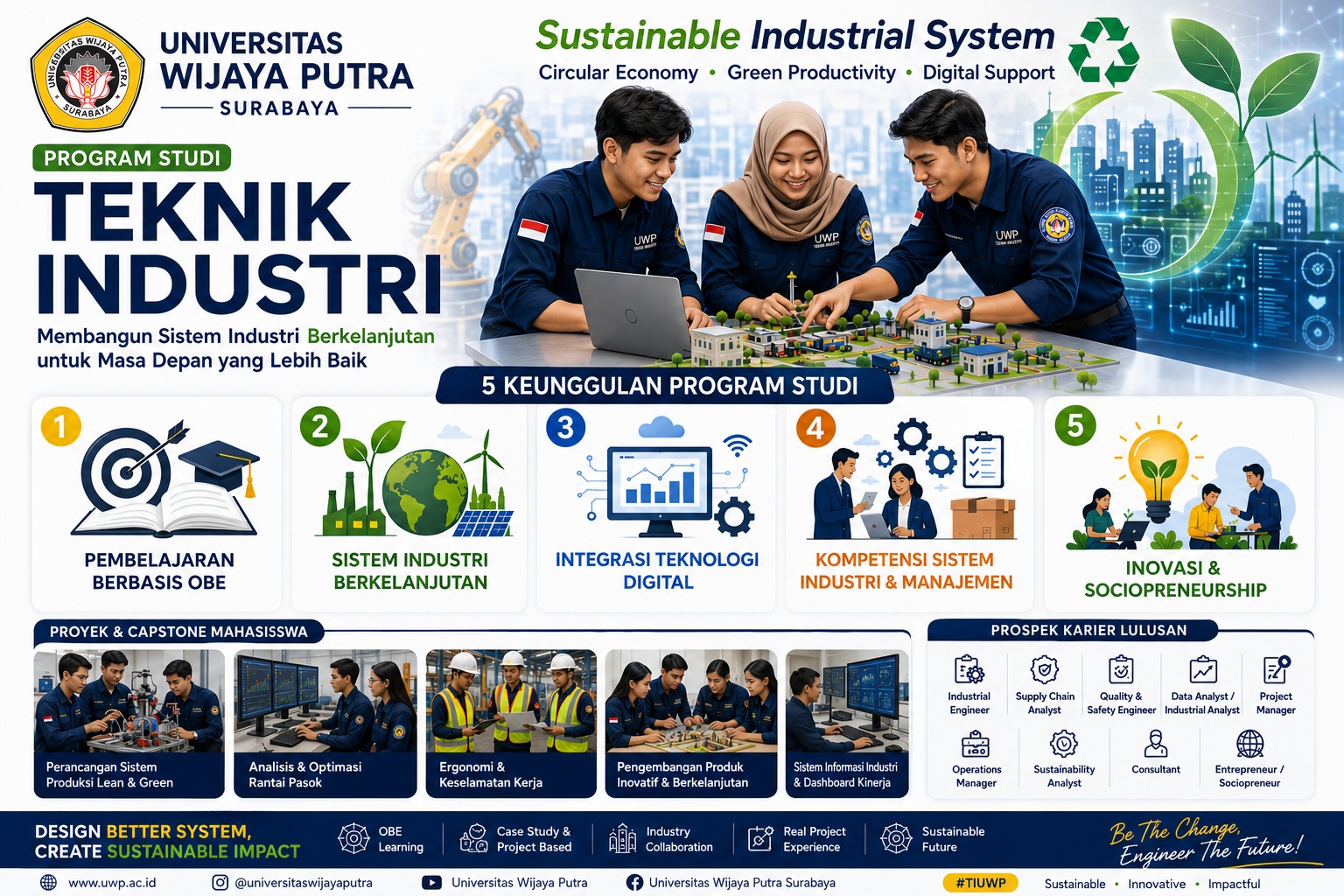
| Program Name | Industrial Engineering (Accredited: Very Good) | |
| Degree | Bachelor of Engineering (S.T.) | |
| Duration | 4 Years | |
| Requirements | High school diploma (SMA/MA/SMK) in any major | |
| Campus Location |
Kampus 1 Jl. Raya Benowo 1-3 Surabaya |
|
| Faculty | Faculty of Engineering | |
| Facilities | Technical Drawing / Product Design Laboratory (AutoCAD) Manufacturing Process Laboratory (Cutting, Grinding, Welding, Drilling, Milling) CNC (Computer Numerical Control) Laboratory Physics Laboratory Computer Laboratory (Simulation, Quality Control Statistics, Manufacturing Systems, Facility Layout) Ergonomics Laboratory Industrial Automation Laboratory | |
| Supporting Facilities | Air-Conditioned Lecture Halls with LCD Projectors Library Faculty Office Department Chair’s Office Parking Area Display Area Cafeteria Place of Worship |
|
| Contact |
IG: teknikindustri_uwp |
|
| Field of Work |
Production Planner (PPIC) |
Vision
“To become a center of excellence in the development of sustainable industrial systems through a circular economy and green productivity approach, supported by digital technology and sociopreneurship insights.”
Mission
Program Outcomes (CPL)
Graduates of the UWP Industrial Engineering program are expected to possess the following competencies:
|
CPL-1 |
Demonstrate professionalism, integrity,
discipline, responsibility, ethics, and concern for occupational safety,
sustainability, and the environment in Industrial Engineering practice. |
|
CPL-2 |
Mastering the concepts of mathematics,
science, engineering, management, and industrial systems to support the
analysis and resolution of Industrial Engineering problems. |
|
CPL-3 |
Able to identify, formulate, analyze, and
solve complex problems in industrial systems using a systems approach and
engineering methods. |
|
CPL-4 |
Able to design, integrate, and improve
industrial systems involving humans, materials, information, energy,
technology, and the environment effectively and sustainably. |
|
CPL-5 |
Able to design, manage, and optimize
production, logistics, and supply chain systems through a circular economy
and green productivity approach. |
|
CPL-6 |
Able to implement and evaluate quality
systems, occupational safety, ergonomics, and continuous improvement to
improve industrial performance. |
|
CPL-7 |
Able to plan, implement, and evaluate projects
and make data-based decisions by utilizing digital and computing technology. |
|
CPL-8 |
Able to design experiments, analyze data, and
interpret results to support development and decision making in industrial
systems. |
|
CPL-9 |
Able to communicate effectively, work in
multidisciplinary teams, and demonstrate leadership skills in organizations
and projects. |
|
CPL-10 |
Able to develop oneself sustainably, be
adaptive to technological and industrial developments, and have
sociopreneurship insight in creating innovative solutions for society. |
Independent Professional Profile
Graduates of the Industrial Engineering program at Universitas Wijaya Putra typically pursue careers as:
|
No |
Graduate Profile |
Competency Description |
|
PL 1 |
Production & Sustainable Manufacturing
Engineer |
Graduates are able to design, manage, and improve
production and manufacturing systems efficiently, productively, and
sustainably through a green productivity and circular economy approach. |
|
PL 2 |
Supply Chain & Industrial Systems Analyst |
Graduates are able to analyze, manage, and optimize
logistics systems, supply chains, and integrated industrial systems with the
support of digital technology to improve industrial efficiency and
sustainability. |
|
PL 3 |
Quality, Safety & Project Engineer |
Graduates are able to
implement and evaluate quality systems, occupational safety, ergonomics, and
project management to support effective, safe, and sustainable industrial
performance improvement. |
|
PL 4 |
Industrial Innovator & Sociopreneur |
Graduates are able to
develop innovative products, processes, and business models based on
Industrial Engineering science that are adaptive, sustainable, and have a
social impact through sociopreneurship insights. |
STUDENT ACHIEVEMENTS (NATIONAL LEVEL)
|
Year |
ACTIVITY |
TITLE |
IMPLEMENTER |
|
2024 |
National
Innovation |
IoT-Based
Solar-Powered Fruit Fly Pest Trap |
Dwi Yunita R dkk |
|
2024 |
National
Innovation |
Eco Burner:
An IoT-Based, Eco-Friendly Self-Burning Waste Processor |
Ainur Dwi R dkk |
|
2023 |
National
MSIB |
Certified
Internship and Independent Study Program at PT. Artificial Intelligent
Indonesia |
Yogi Tri Agustiyan |
|
2023 |
MSIB
Ministry of Education, Culture, Research, Technology and Higher Education |
Bangkit
Program Certified Internship and Independent Study |
Dody Hogo Napitupulu |
|
2023 |
PPK Student
Organization |
Household
Waste Management Based on Circular Economy and Environmentally Friendly
Technology |
Fajar Akhira P, Meirinda Eka
CK, Ainur Dwi R dkk |
|
2023 |
National
Student Organization PPK |
Capacity
Building of Fishermen's Groups on the West Coast of Surabaya City, Tambak
Osowilangun Subdistrict for Fishermen's Socio-Economic Independence |
Chandra Ilham P, Yahya Ahmad
A. dkk |
|
2022 |
National
P2MW |
"Krisada.id “Social Enterprise-Based
Businesses in Greater Surabaya.”" |
Yogi Tri Agustiyan, Lailatul
F, Fajar Akhira P |
|
2022 |
Innovillage Nasional |
"Empowering Clover
Farmers in Semanggi Village Through Efficiency Leaf Drying Using Solar Panel
and IoT-Based Drying Technology." |
Yogi Tri Agustiyan dkk |
|
2022 |
Indonesian
next Telkomsel |
Finalists
of the Indonesian next session 6 Telkomsel |
Dyah Puspita IBSW |
|
2021 |
P2HD
Holistic Village Development and Empowerment Program |
Processing
Household Waste into Alternative Energy Using the Concept of Thromolysis and
Biogas to Create Energy-Independent Villages |
Dyah Puspita IBSW, Moch.
Rizal dkk |
|
2020 |
P2HD
Holistic Village Development and Empowerment Program |
Utilizing
Corn Silk Waste to Make Tea |
Dyah Puspita, Moch. Rizal dkk |
FACULTY RESEARCH ACHIEVEMENTS (NATIONAL LEVEL)
|
Year |
SCHEME |
TITLE |
IMPLEMENTER |
|
2025 |
Regular
Fundamental Research (PFR) |
"Optimizing
the Biodiesel Production Process Using Waste Cooking Oil Integrated Wastewater Treatment System for
Biodiesel To Support Energy Self-Sufficiency" |
Ong Andre
W.R, S.T, MT, M. Hasan Abdullah, S.T, M.MT |
|
2024 |
PDP
(Beginner Lecturer Research) |
Application of Response Surface
Methodology to Optimize the Characteristics Compressive Strength and Water
Absorption of Building Materials from Incineration Ash Household Waste |
Hasan
Abdullah, S.T, M.MT |
|
2024 |
PDP
(Beginner Lecturer Research) |
Analysis of Interest in Buying
Green Products, Environmental Value of Sanitary Napkins Women in Gen Z in
Malang City |
Krisnadhi
Hariyanto, S.T., MM |
|
2023 |
Prototype
Grant |
Prototype of
Biodiesel Production Machine from Waste Cooking Oil Raw Material Based on
Electric Energy from Solar Panels |
Ong Andre
W.R, S.T, MT, M. Hasan Abdullah, S.T, M.MT |
|
2020 |
PDP
(Beginner Lecturer Research) |
"Designing
a Sustainable Development Strategy Based on Co-optation Competition Between
the MSME Sector of Seafood Products and Tourism Kenjeran Beach, Surabaya, to
Create Potential Ecological Industrial Parks (EIP)" |
Astria
Hindratmo, S.T., MT |
FACULTY COMMUNITY SERVICE ACHIEVEMENTS (NATIONAL LEVEL)
|
Year |
SCHEME |
TITLE |
IMPLEMENTER |
|
2025 |
Community
Partnership Program |
Increasing the
Production Capacity and Quality of Milkfish Processing Businesses Using the
TTG Bone Tenderizer Machine in Sumber Rejo Village, Pakal District, Surabaya
City |
Ir. Subaderi,
MM. (A) |
|
2025 |
Community
Partnership Program |
"Empowering
Community Partnerships to Improve the Quality and Capacity of Banana Chip
Businesses in Supporting National Independence Based on a Green
Economy in Sidowungu Village, Menganti District, Gresik Regency" |
Krisnadi
Hariyanto, S.T., M.M. (A) |
|
2025 |
Community
Partnership Program |
Increasing the
production capacity and quality of traditional dry cake businesses in
Randupadangan, Menganti, Gresik |
Ampar Jaya
Suwondo, ST., MT. |
|
2025 |
Community
Partnership Program |
Optimizing the
Management and Production of Bu Sumi's Dawet with the Siwalan Fruit Chopping
Machine in Hendrosari, Gresik |
Krisnadi
Hariyanto, S.T., M.M. |
|
2025 |
Community
Partnership Program |
Improving the
Capacity and Management of Bakery SMEs Through Lean Halal-Based Production in
Gilang Village, Babat District, Lamongan Regency |
M. Hasan
Abdullah, S.T., M.MT. |
|
2024 |
Community
Partnership Program |
"Increasing
the Production Capacity and Quality of Kriuk Wader Fish Farming By Using TTG
Wader Dryers in Sidokepung Village, Buduran District, Sidoarjo Regency" |
M. Hasan
Abdullah, S.T., M.MT. (A) |
|
2023 |
Community
Partnership Program |
"Mainstreaming
the Green Economy: Coffee Shop Neira, Surabaya City As Economic
Recovery for MSMEs" |
Krisnadi
Hariyanto, S.T., M.M. (A) |
|
2023 |
Community
Partnership Program |
"Improving
the Capacity and Management of Spice Entrepreneurs Kertonyono
Wedangan Spices with a Spice Drying Machine Spices at Jalan
Raya Benowo No. 06, Pakal District, Surabaya City" |
Ir. Subaderi,
MM. (A) |
|
2022 |
Community
Partnership Program |
"Implementation
of Eco-Friendly Tofu Waste Processing Manufacturing and Green Energy in Tofu
SMEs in Klepek Village Kediri Regency" |
Astria Hindratmo,
S.T., |
|
2021 |
Community
Partnership Program |
"Implementing
Stability and Continuity in the Fish Smoking Process SMEs in Penatarsewu
Village, Tanggulangin, Sidoarjo Community Partnership Program" |
Krisnadi
Hariyanto, S.T., M.M. (A) |
|
2021 |
Community
Partnership Program |
"Implementation
of Independent Market Waste Management Based on a Circular Economy System and
Eco-Friendly Technology in Kunjang Village, Kunjang District, Kediri Regency Community
Partnership Program" |
Astria Hindratmo,
S.T.,M.T., M. Hasan Abdullah, S.T., M.MT. |
|
2020 |
Community
Partnership Program |
Traditional
Beverage Business "Wedang Segar" in Madiun Regency |
Onny Purnamayudhia,
S.T., M.M., Ampar Jaya Suwondo, ST., MT. |
|
2020 |
Community
Partnership Program |
"Lakarsantri
Village Housewife Business Group Surabaya City Community Partnership
Program" |
Ir. Subaderi,
MM. (A) |
No Semester MK Code Courses SKS 1 1 00A001 RELIGIOUS EDUCATION 2 2 00A008 INDONESIAN 2 3 00A013 PANCASILA 2 4 00A014 CITIZENSHIP 2 5 52A001 ENGLISH 2 6 50B001 TECHNICAL DRAWING 2 7 52B002 BASIC PHYSICS I 2 8 52B024 INTRODUCTION TO INDUSTRIAL ENGINEERING 2 9 52B025 TECHNICAL DRAWING PRACTICE 1 10 52B037 CALCULUS 1 3 Sub
Jumlah 20 No Semester MK Code Courses SKS 1 2 52B005 BASIC PHYSICS 2 2 2 52B009 ENGINEERING MATERIALS 2 3 52B011 ENGINEERING MECHANICS 2 4 52B026 INTRODUCTION TO ECONOMICS 2 5 52B027 ALGORITHMS AND COMPUTER PROGRAMMING 3 6 52B028 INDUSTRIAL AUTOMATION 2 7 52B029 MANUFACTURING PROCESS 2 8 52B039 CALCULUS 2 3 9 52B013 PHYSICS PRACTICAL 1 10 52B019 MANUFACTURING PROCESS PRACTICE 1 Sub
Jumlah 20 No Semester MK Code Courses SKS 1 3 00A009 ANTI-CORRUPTION EDUCATION 2 2 52B018 OPERATIONAL RESEARCH I 3 3 52C005 ERGONOMICS & APK PRACTICAL 1 4 52B031 LINEAR ALGEBRA 2 5 52B032 STATISTICS I 2 6 52B038 INDUSTRIAL CHEMISTRY 2 7 52B014 COST ANALYSIS AND ESTIMATION 2 8 52C080 ERGONOMICS 2 9 52C058 WORK DESIGN AND MEASUREMENT 2 10 52C085 INDUSTRIAL AUTOMATION PRACTICAL 1 Sub
Jumlah 19 No Semester MK Code Courses SKS 1 4 52B021 OPERATIONAL RESEARCH II 3 2 52B033 STATISTICS II 3 3 52B034 OPTIMIZATION MATHEMATICS 2 4 52B035 ENGINEERING ECONOMICS 2 5 52B036 DATA ANALYTICS 2 6 52C064 INDUSTRIAL ENVIRONMENTAL SYSTEM 2 7 52B022 STATISTICS PRACTICE 1 8 52D001 INDUSTRIAL PSYCHOLOGY 2 9 52C060 PRODUCTION PLANNING AND CONTROL 3 Sub
Jumlah 20 No Semester MK Code Courses SKS 1 5 52C015 MANUFACTURING SYSTEM 3 2 52C019 MANUFACTURING SYSTEM PRACTICAL 1 3 52C062 QUALITY CONTROL AND ASSURANCE 3 4 52C012 QUALITY CONTROL PRACTICAL 1 5 52C063 LOGISTICS MANAGEMENT 3 6 52D003 WRITING AND SCIENTIFIC COMMUNICATION 2 7 52C067 SYSTEM MODELING 3 8 52C075 EXPERIMENTAL DESIGN 3 Sub Jumlah 19 No Semester MK Code Courses SKS 1 6 52C069 BUSINESS INFORMATION SYSTEM DESIGN 3 2 52C086 FACILITY LAYOUT PRACTICAL 1 3 52C006 FACILITY LAYOUT DESIGN 3 4 52C082 INTEGRATED PRACTICUM 3 5 52C068 INDUSTRY FEASIBILITY ANALYSIS 3 6 52C070 SUPPLY CHAIN MANAGEMENT 2 7 52C066 TECHNOPRENEURSHIP 3 8 00E001 STUDENT WORK LECTURES 2 9 322C24 OPTION -1 :MCDM 3 Sub
Jumlah 23 No Semester MK Code Courses SKS 1 7 52C081 INTEGRATED SYSTEM DESIGN (capstone design) 2 2 52C073 SYSTEM SIMULATION 3 3 52C026 INDUSTRIAL SYSTEM SIMULATION PRACTICAL 1 4 52C077 OCCUPATIONAL HEALTH AND SAFETY 2 5 52C056 PRODUCT DESIGN AND DEVELOPMENT 3 6 52C083 RESEARCH METHODOLOGY 3 7 52C084 DESIGN AND MANAGEMENT OF INDUSTRIAL ORGANIZATIONS 3 8 52C046 OPTION -2 :LEAN MANUFACTURING 3 9 52C011 OPTION -3 : PROJECT MANAGEMENT 2 Sub Jumlah 22 No Semester MK Code Courses SKS 1 8 52C016 PRACTICAL WORK 2 2 52C030 THESIS 5 Sub
Jumlah 7 Jumlah
SKS 150Year One
Year Two
Year Three
Year Four
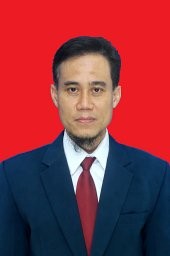 Ong Andre Wahyu Riyanto, S.T., MT |
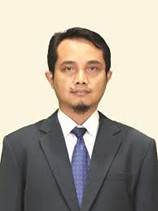 M. Hasan Abdullah, S.T., M.MT |
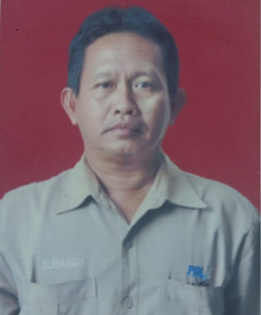 Ir. Subaderi, MM |
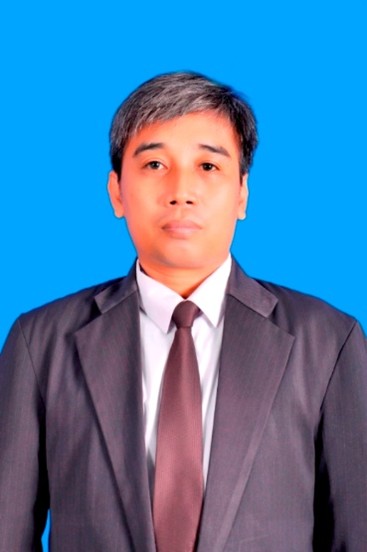 Krisnadhi Hariyanto, S.T., MM |
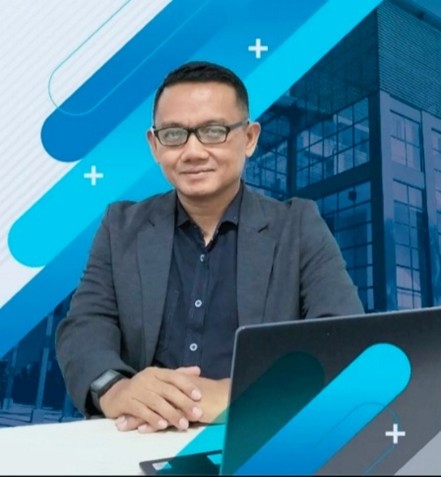 Onny Purnamayudhia, S.T., S.E., MM |
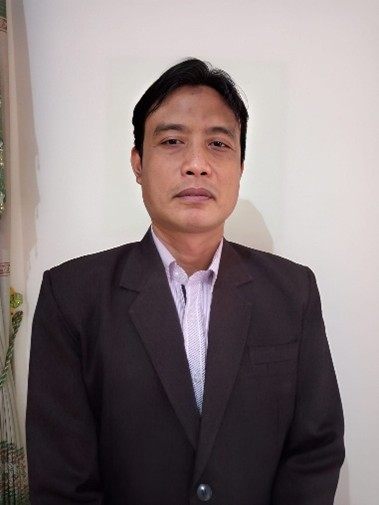 Ampar Jaya Suwondo, S.T., MT |
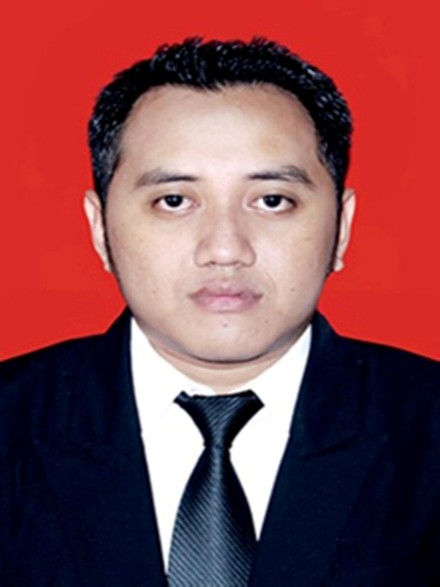 Astria Hindratmo, S.T., MT |
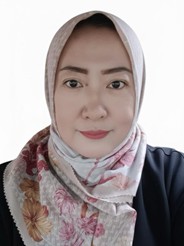 Fitriya Gemala Dewi, S.T., M.MT |
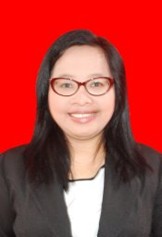 Chendrasari Wahyu Oktavia, S.Si., MT |
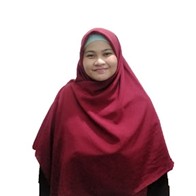 Dyah Puspita Indah Budi Sari Wulan, S.T., MT |


