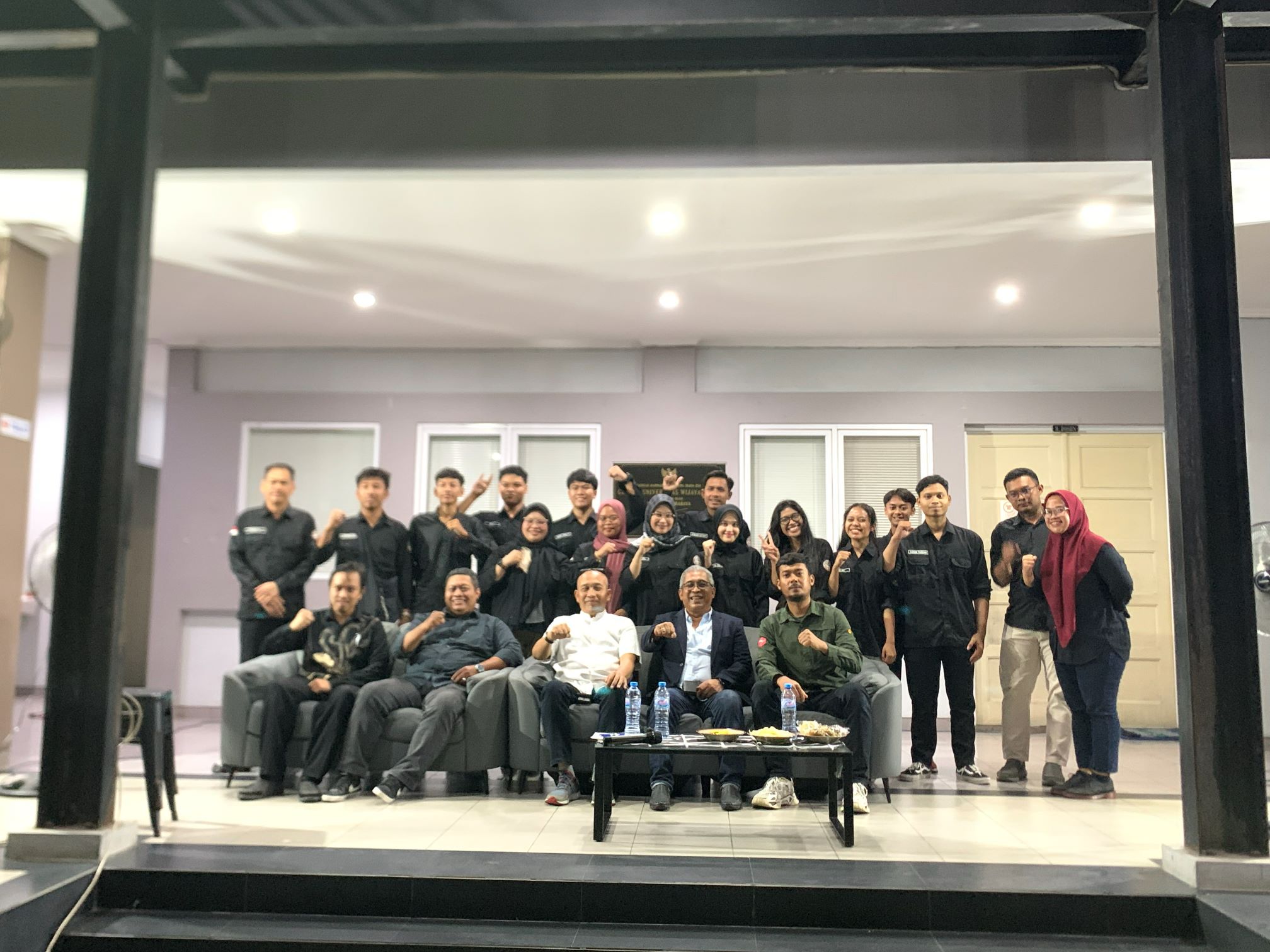
TO PREVENT RADICALISM ON CAMPUS, THE UWP FH BEM HOLDS AN ANTI-RADICALISM AND TERRORISM LEGAL STUDY
The Student Executive Board of the Faculty of Law, Wijaya Putra University (BEM FH UWP) held a legal study session on Friday, September 26, 2025, at the outdoor field of the Faculty of Law, UWP.
The speakers at the session were Dr. Dani Teguh Wibowo, S.H., M.H., from the Indonesian National Police (POLRI) Special Detachment 88, and Arif Fatoni, a victim of radicalism and former terrorist inmate. The session was moderated by the Dean of the Faculty of Law, Dr. Andy Usmina Wijaya, S.H., M.H.
Before hundreds of participants, Arif Fatoni recounted how he was initially exposed to radicalism. It began with an invitation to a study session when he was a freshman at a state university in East Java. However, the study session was infiltrated by radical ideas and ideologies, leading to his involvement in jihad, ultimately leading to his joining a terrorist organization.
"Eventually, I even went to Syria, although I was eventually detained and deported in Turkey," Arif said.
The turning point for him was when he was detained on Nusakambangan Island. At that time, he learned that his previous beliefs were wrong. Thanks to guidance from various parties, he managed to find his way back to a moderate and peaceful path.
"Radicalism is the wrong path. I hope my experience can be a lesson for everyone, especially students who are often in a period of self-discovery," Arif said to the audience, mostly new students from the Faculty of Law, University of West Java (UWP) and members of the Student Executive Board (BEM).
In the next session, Dr. Dani Teguh Wibowo presented on the threat of radicalism and terrorism, which remain major challenges for Indonesia. He explained how radicalization can lead to acts of terror that disturb society.
He explained that there are three pillars of radicalism. The first relates to a constructed narrative, such as the narrative of jihad, which is misinterpreted, giving rise to the seeds of radicalism. The second is the existence of a network or social ties. Moreover, as a new student, with all their busy schedules, bonds with family begin to diminish, gradually losing their sense of identity, making them susceptible to radical thinking. Third, there are needs, such as the need to understand something, the need for self-existence, and so on.
"If all three of these pillars are present, that's when a person is infiltrated by radical thinking, which can lead to terrorism," said Dani.
Therefore, he hopes for close collaboration between the government, the National Police (Polri), the Indonesian National Armed Forces (TNI), religious leaders, community leaders, and relevant stakeholders in combating the spread of radical ideology.
"The state cannot act alone; it must involve stakeholders, such as the academic community on campus, to combat radicalism," he concluded.
The head of the organizing committee, Dimas Willy Andrianto, stated that the chosen theme aims to prevent UWP Law students from being easily infiltrated by radical ideology.
"Legal studies are a routine agenda held by the UWP Faculty of Law Student Executive Board. This time, we chose a theme related to anti-radicalism, which we hope will prevent new students undergoing PKKMB from being easily exposed to ideologies that conflict with the Unitary State of the Republic of Indonesia," said Dimas, who is also the Deputy Chair of the UWP Faculty of Law Student Executive Board.