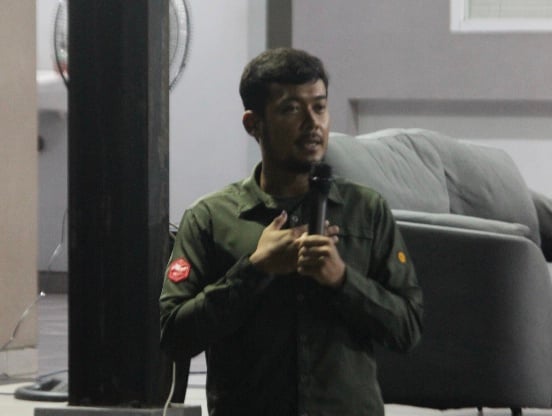
The True Story of a Former Terrorist Convict Reveals How He Recruited Members on Campus and Departed for Syria
The threat of the spread of radical ideology is increasingly disturbing, even starting to target educational settings. This situation prompted the Student Executive Board of the Faculty of Law, Wijaya Putra University (BEM FH UWP) to hold a legal study entitled "Countering the Spread of Radicalism in the Surrounding Environment" on Friday (September 26, 2025) at the outdoor field of the UWP FH campus in Surabaya.
This event featured prominent speakers, including a representative of the National Police's Densus 88 Anti-terror Unit, Dr. Dani Teguh Wibowo, S.H., M.H., and Arif Fatoni, a former terrorist convict who now actively educates about the dangers of radicalism. The discussion was moderated by the Dean of the UWP FH, Dr. Andy Usmina Wijaya, S.H., M.H.
The Story of a Former Terrorist Convict: From Campus to Syria
In the forum, Arif Fatoni shared his personal experience of being caught up in radical ideology.
He admitted that he initially only participated in religious studies at a state university in East Java. However, the studies were infiltrated by a deviant ideology that led participants to a false understanding of jihad.
"I even tried to go to Syria. However, I was detained in Turkey and ultimately deported. My turning point came while serving my sentence on Nusakambangan. That's when I realized that the path I had chosen was a huge mistake," Arif told hundreds of new students at the Faculty of Law, University of West Java (UWP).
He emphasized that radicalism is simply a dead-end path that leads to deception. Therefore, Arif hopes his experience can serve as a valuable lesson for the younger generation so they won't be easily provoked.
Meanwhile, Dr. Dani Teguh Wibowo from Densus 88 explained that the process of radicalization typically develops through three main pillars. First, a false narrative that transforms the meaning of jihad into a call to violence. Second, social networks, where new students far from their families often seek a new identity and are more vulnerable to exposure. Third, existential needs, such as the desire to understand religion more deeply or seek self-validation.
"If these three factors converge, it's very easy for someone to fall into radical thinking. Therefore, the role of the campus, government, the Indonesian National Armed Forces (TNI) and the Indonesian National Police (Polri), religious leaders, and the community is crucial in preventing its spread," Dani emphasized.
The event's organizing committee, Dimas Willy Andrianto, stated that the anti-radicalism theme was chosen to provide UWP Law Faculty students with a strong defense against ideologies that conflict with Pancasila and the Unitary State of the Republic of Indonesia (NKRI).
"This Legal Studies Program is a regular agenda of the UWP Law Faculty Student Executive Board (BEM). This time, we are focusing on preventing radicalism so that new students are more vigilant from the beginning of their studies," said Dimas, who is also the Deputy Chair of the BEM.
Through this activity, the campus hopes that students will not only be academically intelligent but also develop a strong sense of nationalism, enabling them to become agents of peace in society.
INEWS SURABAYA