The New Criminal Code Will Be Implemented in 2026, Discussed in Depth in Gresik, Here's a Summary of Key Points
A warm and
enthusiastic atmosphere filled the Gresik Regency Government Convention Hall on
Thursday (November 27, 2025), as academics, law enforcement officers,
advocates, and students gathered to discuss the future of Indonesia’s criminal
law.
The same spirit brought them together under one shared goal: ensuring that
society is prepared to welcome the implementation of the national Criminal Code
(KUHP) in January 2026.
The event,
titled “Implications of the Enforcement of Law Number 1 of 2023 on the
Criminal Code and the Role of Law Enforcement Agencies in Criminal Law
Enforcement”, was organized by the Gresik branch of PERADI in collaboration
with the Gresik Regency Government, Airlangga University (UNAIR), and Wijaya
Putra University (UWP).
This National
Seminar presented prominent figures in the field of law, including the Deputy
Coordinating Minister for Law and Human Rights, Prof. Dr. Otto Hasibuan, S.H.,
M.M., who served as the keynote speaker. In addition, several speakers from
various institutions enriched the discussion, ranging from judges and
prosecutors to academics and legal practitioners.
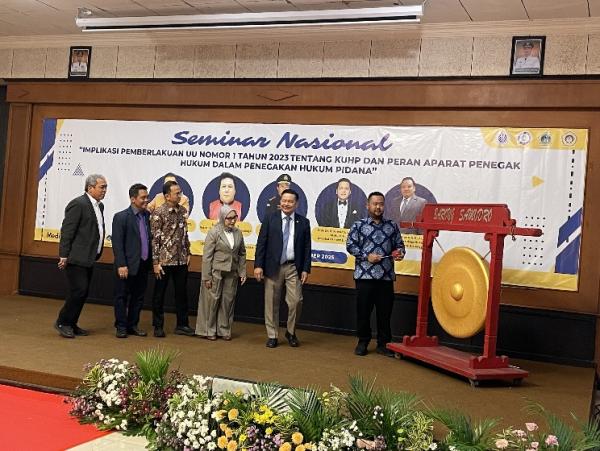
The event was
officially opened by the Regent of Gresik, H. Fandi Akhmad Yani, S.E., M.MB.,
with the striking of a gong, accompanied by representatives from the central
government, PERADI National, UNAIR, and UWP.
In his
presentation, Prof. Otto emphasized that Indonesia is entering an important
phase in the history of its criminal law. After decades of using a Criminal
Code inherited from the colonial era, the country is now preparing to implement
a set of rules formulated based on the nation's own values and needs.
“On January 2,
2026, we will officially adopt the National Criminal Code, which has been
aligned with Indonesian legal concepts. This is a major step for our nation,”
Prof. Otto asserted.
However, he
also reminded the audience of the challenges ahead, such as the application of
the Living Law—customary laws that live within society—as well as the
introduction of new types of punishment, including community service.
“That is why
discussions like this are crucial. Local governments, academics, and
practitioners need to provide input for drafting the technical regulations that
will guide the implementation of the KUHP,” he added.
The Rector of
Wijaya Putra University, Dr. Budi Endarto, S.H., M.Hum., expressed full support
for the implementation of the National Criminal Code. According to him,
universities are not only educational institutions but also sources of insight
for the government and legal authorities.
“We have many
experts within UWP’s Faculty of Law. They are ready to assist the central
government, the House of Representatives, and regional administrations in
formulating the technical rules of the KUHP,” Budi said.
He emphasized
that this initiative aligns with UWP’s vision as a Sociopreneur University,
which highlights tangible societal impact through research and scientific
activities.
The
enforcement of the National Criminal Code is not merely a change in regulations
but also a shift in society’s perspective on law. This seminar served as a
forum for various stakeholders to understand, critique, and provide input to
ensure that the KUHP can be implemented effectively and humanely.
Through the
collaboration of government, academia, and law enforcement, Gresik demonstrates
its commitment to being a proactive region in facing this significant
transition.
iNewsSurabaya.id