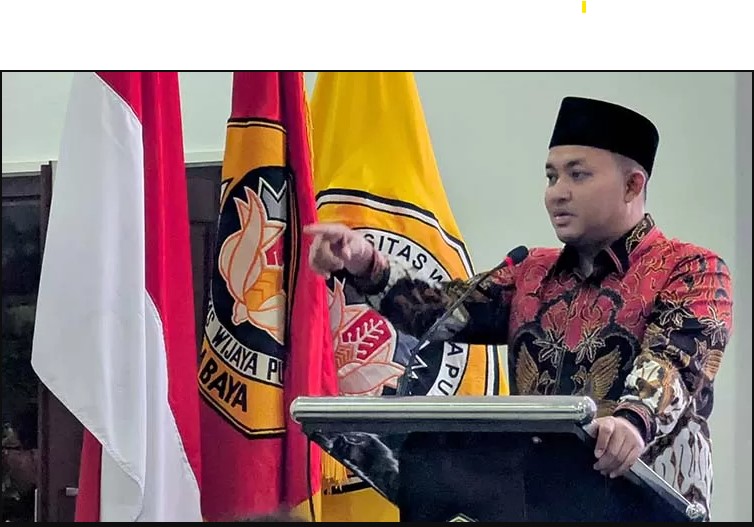
Give Space to Academics, This is Pasuruan Regent Mas Rusdi's View Regarding the Presidential Threshold
Pasuruan Regent, HM Rusdi Sutejo
appreciated the seminar entitled "Presidential Threshold Decision in the
General Election Post Constitutional Court Decision". The reason is, the
seminar can be a strategic forum in responding to the dynamics of Indonesian
state administration.
In fact, it can also be a space for
reflection for academics and stakeholders, in looking at the future. Especially
in terms of an inclusive and democratic election system. "We really
appreciate this activity. Because it can be a forum for exchanging
opinions," said Mas Rusdi-his nickname.
The seminar, which took place on
Saturday (10/5) night, was held at the Wijaya Putra University (UWP) Campus in
Gambiran Village, Prigen District, Pasuruan Regency. A number of speakers from
various circles, from academics to regional officials, provided in-depth views
on changes to the presidential and vice presidential nomination threshold.
Mas Rusdi believes that experience in
the world of politics must be accompanied by the ability to read opportunities
strategically. "Law is never separate from politics, because law is a
political product between the DPR, the President, and the Government. The
Constitutional Court has decided the threshold to be zero percent, meaning this
opens up opportunities as widely as possible. Even for village people to run
for president," he explained.
He emphasized that although the
Constitutional Court's decision is final, its implementation still requires
further discussion in the DPR. He also encouraged law students to study this
phenomenon critically as important learning material in the study of constitutional
law.
On the other hand, an expert in State
Administrative Law from the Faculty of Law, Wijaya Putra University, Dr.
Suwarno Abadi, S.H., M.Sc., who was the main resource person explained that the
Constitutional Court (MK) decision Number 90 / PUU-XXI / 2023 which regulates
the age limit for presidential and vice presidential candidates became the
entry point for new debates, which was then followed by the Constitutional
Court decision Number 62 / PUU-XXI / 2023 regarding the elimination of the
presidential threshold.
"Law Number 7 of 2017 concerning
Elections has been tested 33 times, and all of them were rejected. However,
this time, the test was carried out without the assistance of a legal counsel,
which could give the impression that there was a shift in direction or perhaps
part of a disampling opinion," he explained.
Meanwhile, responding to this, Andri
Wahyudi as a Member of the Pasuruan Regency DPRD from the PDI Perjuangan
Faction, assessed that the articles in Law Number 7 of 2017 actually lead to
the elimination of the presidential nomination threshold.
He emphasized that if this
elimination is implemented, the impact will be significant on the upcoming 2029
Election contestation. Andri Wahyudi said that the Constitutional Court's
Decision is final and binding. Therefore, PDI Perjuangan supports every legal
decision issued by the Constitutional Court. Although procedurally, of course,
a revision of the law is needed.
"The presidential threshold,
which currently sets a threshold of 20 percent of seats or 25 percent of the
national vote, is a system that provides a limit, whether a candidate is
supported by a political party or a coalition of parties," he explained.
Dr. Kasiman, a member of the DPRD
from the Gerindra Faction. For him, the presidential threshold is the minimum
limit for the acquisition of votes by a political party or coalition of parties
to support a presidential and vice presidential candidate pair. Therefore, it
is related to the legal and constitutional aspects of the presidential
threshold.
He explained that the regulation of
the threshold is contained in Article 222 of Law Number 7 of 2017, with the
main legal basis referring to the 1945 Constitution, especially Article 6A and
Article 22E.
"The presidential threshold aims
to filter presidential candidates so that there are not too many, avoid vote
fragmentation, and maintain government stability. However, if it is abolished,
this must be studied carefully because it is related to the democratic system
and the role of the legislature as a policy maker," he explained. (one)