Can a salary below the UMK be punished? FH UWP Book Review on Employment Law
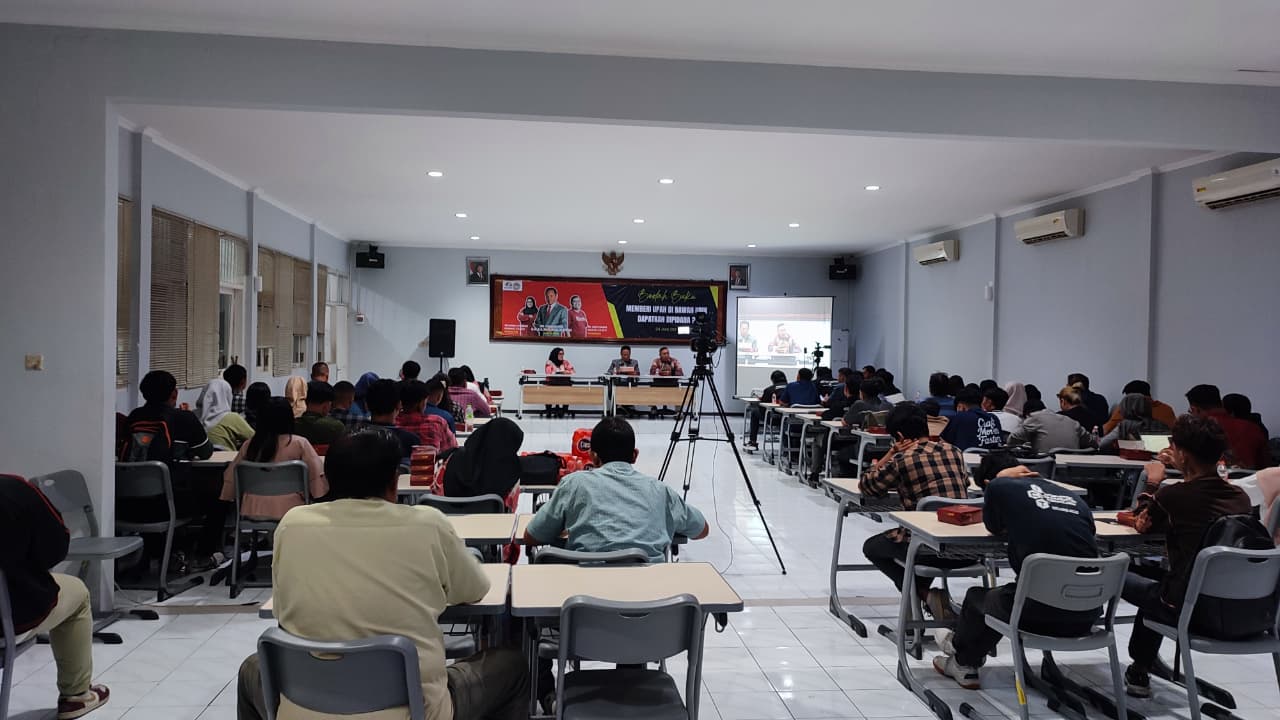
A warm academic atmosphere enveloped the Wijaya Putra University (UWP) Benowo Campus Hall on Thursday 4 April 2026. In the midst of the 45th Anniversary celebration, the UWP Faculty of Law (FH) held a book review event with the shocking headline, namely "Giving wages below the minimum wage, can you be punished?"
The event which took place since this morning presented the main resource person and book author, Dr. Chamdani, who collaborated with Nobella Indradjaja, MH. in his book entitled "Employment Law: Legal Protection of Workers'/Labourers' Wages for the Minimum Wage After the Issue of the Job Creation Law in an Employment Crime Perspective". Appearing as a responder, Dr. Andy Usmina Wijaya, who also serves as Dean of FH UWP, provided a critical perspective.
The event was officially opened by Dr. Dwi Lesno Panglipursari as Chair of the 45th Anniversary Committee. The symbolic moment of handing over certificates to resource persons, responders and moderators opened a warm discussion.
In his presentation, Dr. Chamdani thoroughly discussed his research. He emphasized that labor regulations in Indonesia clearly prohibit companies from paying employees below the Municipal Minimum Wage (UMK). However, he also opened up space for discussion with his outspoken statements.
He explained that exceptions were only given to Micro and Small Enterprises (UMK) which were allowed to determine wages based on an agreement. However, unlike medium and large scale businesses, they are required to follow MSE regulations. Unfortunately, the reality on the ground often shows the opposite because many companies do not comply, and even pressure employees.
So, what is the solution? Dr. Chamdani reminded that the state has provided a legal protection instrument, namely the Industrial Relations Dispute Settlement Procedure Law (PPHI). This process can even lead to the criminalization of negligent entrepreneurs.
"The PPHI Procedural Law essentially means that business people and workers don't need to be afraid of negotiating wages," he stressed.
The next session, Dr. Andy Usmina expressed high appreciation for the publication of this book. As an academic who often teaches labor law, Andy revealed that many workers do not yet know the legal protection mechanisms they can take.
"There is a bipartite negotiation mechanism between employers and workers. If it fails, proceed to tripartite by involving the employment service. Only if it gets stuck, litigation or court can be taken," explained Andy.
The enthusiasm of the participants was unstoppable. The majority of students from FH, Faculty of Social and Political Sciences (FISIP), and Faculty of Economics and Business (FEB) UWP have been working in turns holding the microphone. They shared the harsh reality of wages in their respective workplaces.
Responding to this, Dr. Chamdani gave effective tips "Strengthen the evidence! Keep pay slips, collect documentation, strengthen arguments. Then take procedural law. The hope is that entrepreneurs can be aware without having to be imprisoned. The function of this regulation is to protect workers, not to imprison entrepreneurs. It could be their ignorance or negligence. That's why in PPHI, negotiation is the first step, court is the last option."
The person in charge of the activity and UWP FH Lecturer, Fikri Hadi, MH., said that this book review agenda is a routine program every Anniversary. The issues raised are always relevant and close to society.
"The issue of wages is always problematic. Therefore, we are holding this book review and broadcasting it live on YouTube UWP News. This is a real manifestation of FH UWP's commitment to impact, in line with the vision of research-based excellence and Legalpreneurship," concluded Fikri.
This event full of ideas is not only an arena for academic discussion, but also a space for advocacy for workers. FH UWP has once again proven its role as an intellectual home that cares about social justice, law and humanity.